
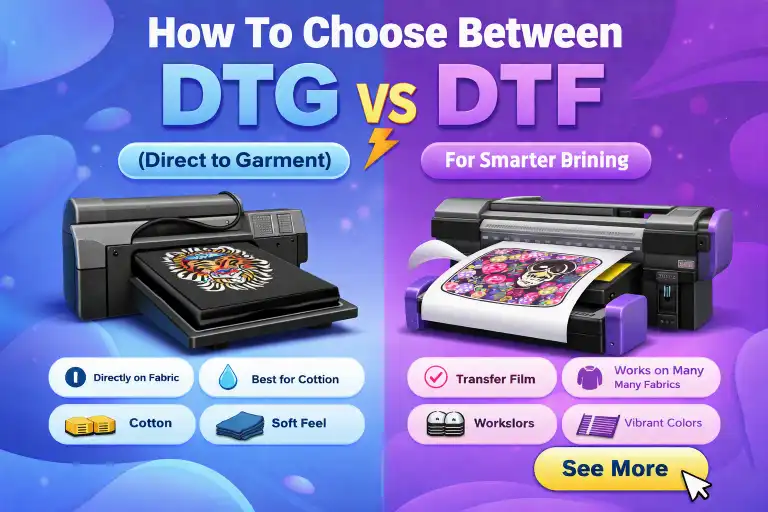
In the evolving landscape of apparel decoration, the choice between Direct-to-Garment (DTG) and Direct-to-Film (DTF) printing is not merely a technical preference; it is a fundamental business strategy.
For shop owners and brand managers, these two technologies represent different ways to solve the same problem: getting a design onto a substrate with the highest possible efficiency and profit margin.
Whether you are scaling a startup or optimizing a high-volume facility, choosing between Direct-to-Garment (DTG) and Direct-to-Film (DTF) printing methods is not just a technical choice.
It is an important business decision in apparel decoration. For shop owners and brand managers, DTG and DTF are two ways to solve the same problem.
They help put a design on a material with the best efficiency and profit.
Shifting the Focus from “Machine” to “Product Outcome”
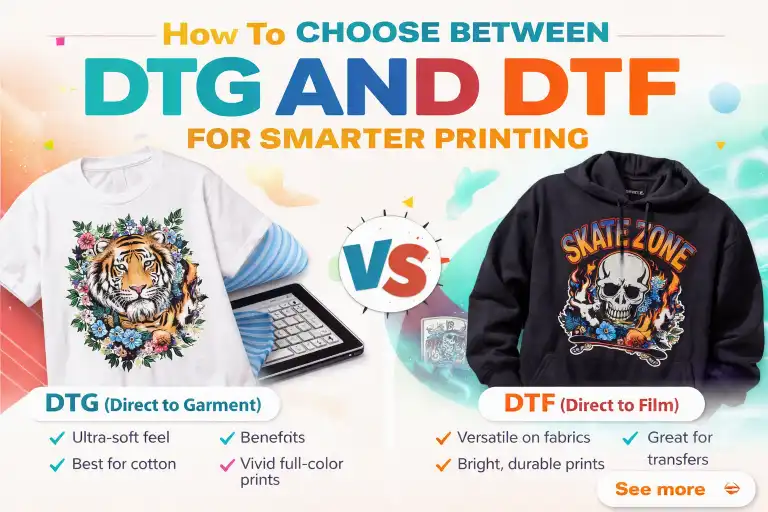
Many decorators fall into the trap of obsessing over hardware specifications while ignoring the end-user experience.
Many decorators focus too much on hardware details. They forget about the experience of the end user.
A successful business strategy pivots from “Which printer should I buy?” to “What product outcome does my customer demand?”
If your primary output is high-end, retail-ready garments where “hand feel” is paramount, your operational focus shifts toward DTG. Conversely, if your business thrives on high-volume fulfillment, custom merchandise for varying fabric types, or complex event gear, the versatility of DTF becomes your competitive advantage.
The machine is the engine, but the product outcome is the destination.
The Evolution of Digital Printing: From Inkjet Technology to Modern Transfers
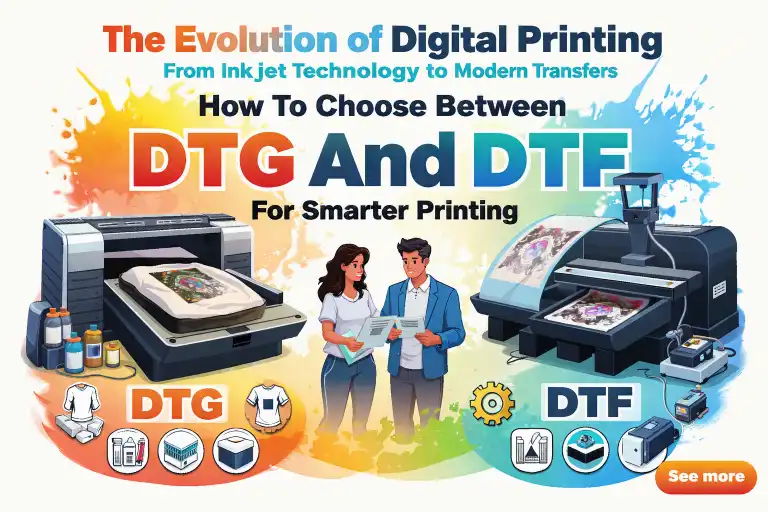
Digital printing has moved far beyond the basic inkjet technology of the early 2000s, which often struggled with limited substrate compatibility.
DTG printing has become a detailed chemical staining process. Modern DTF technology has changed “transfers” from old, rubbery iron-ons into a high-quality, industrial application.
While the industry once relied heavily on screen printing—a process defined by the legacy of Johannes Gutenberg and the precision of movable type printing—the modern era of custom apparel printing is defined by computerized printers.
Understanding this evolution helps you appreciate why each method occupies a specific, essential niche in today’s professional print shops.
Direct-to-Garment: The Ink-to-Fiber Infusion Process
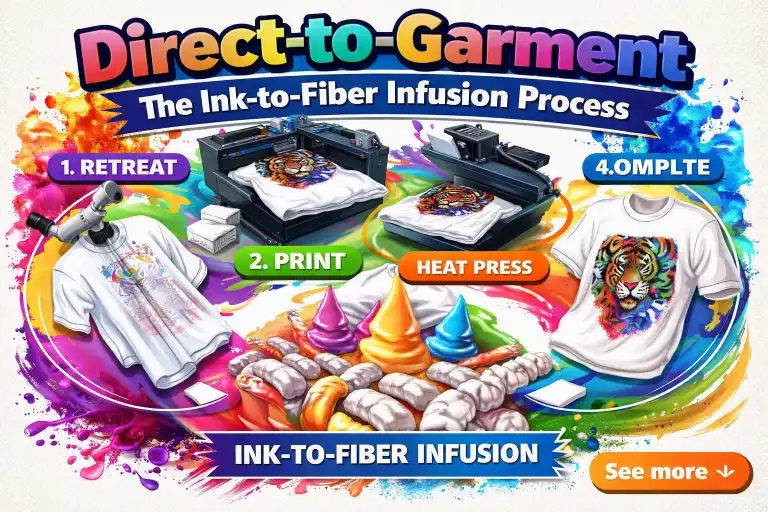
DTG printing is essentially a precise, digital form of staining.
The process relies on water-based inks that are injected directly into the fabric fibers.
For dark-colored fabrics, you need a pre-treatment agent. It creates a chemical barrier.
This lets the white ink base stay on the fiber surface instead of soaking into the fabric.
Because the ink molecules and fabric fibers join well, the final product is very soft. Often, it feels like the original material.
Using a high-quality DTG printer, operators can achieve intricate, photo-realistic artwork that remains breathable and soft to the touch.
Direct-to-Film: The Mechanical Bond of PET Film and Adhesive Powder
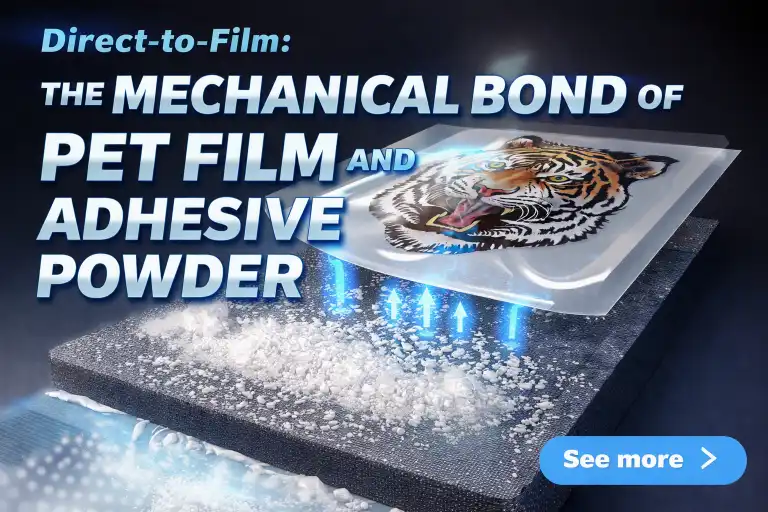
Direct-to-film printing is a thermal lamination process that offers incredible flexibility.
Your digital design is printed onto a special film, which acts as a carrier. After printing, you apply a heat-melt adhesive powder to the wet ink.
Once passed through a curing oven, the result is a ready-to-press transfer.
When using a heat press, that adhesive layer melts and physically bonds the ink layer to the surface of the fabric.
The design does not soak into the fibers; it sits on top, creating a mechanical bond that is robust across many fabric types.
The Role of Water-Based Inks vs. Heat-Melt Adhesive Chemistry
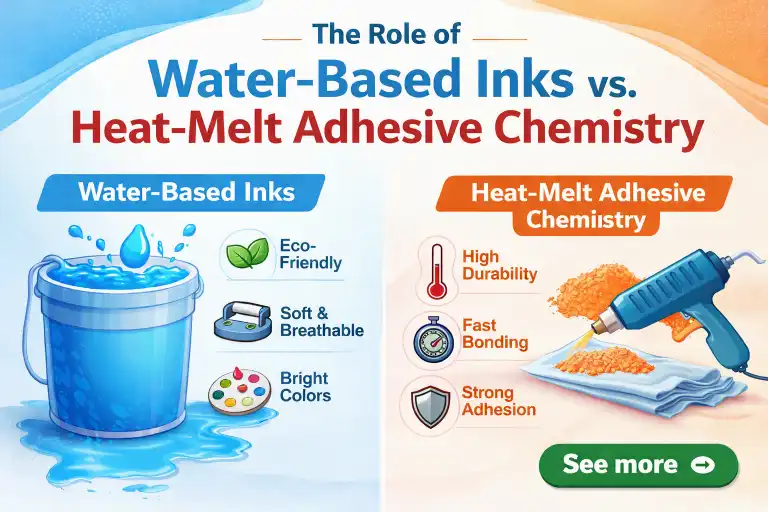
The chemistry defining these two methods dictates their performance.
DTG relies on water-based inks interacting with natural fibers, making it the industry standard for 100% cotton garments.
In contrast, DTF utilizes a sophisticated heat-melt adhesive powder. This chemical bridge allows the ink to adhere to synthetic materials like nylon jackets or polyester blends that would typically reject water-based inks.
By understanding the chemistry behind the print, you can better select the appropriate printing method for your specific inventory.
Handling Gradients, Fine Lines, and Photo-Realistic Artwork

Both methods are highly capable of producing professional-grade, full-color designs.
DTG excels at capturing subtle gradients and intricate fine lines because the ink penetrates the fabric, offering a seamless integration that is ideal for high-end boutique apparel.
DTF can handle these details as well, though the use of transfer films means that extremely fine, “faded-to-nothing” edges can sometimes appear slightly more structured.
However, for most photo-realistic artwork, both methods provide exceptional clarity if the digital file is prepared with proper CMYK color processing.
Achieving Color Saturation: CMYK Processing and the White Underbase
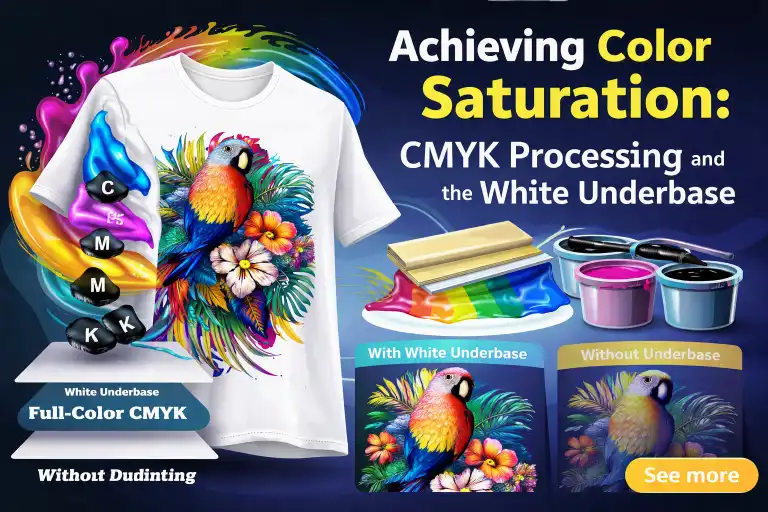
Achieving professional print quality requires a solid white underbase.
In DTG printing, this layer is printed directly onto the pre-treated fabric, followed by the CMYK color layer.
This can sometimes lead to color blending if the pre-treatment is not uniform. DTF simplifies this: the white layer is printed over the CMYK colors on the specialized film.
Because the white is printed on a consistent, non-absorbent surface, the color vibrancy and saturation in DTF are often inherently higher, allowing for more consistent results across different production batches.
Why DTF Excels at Solid Vectors and High-Vibrancy Graphics
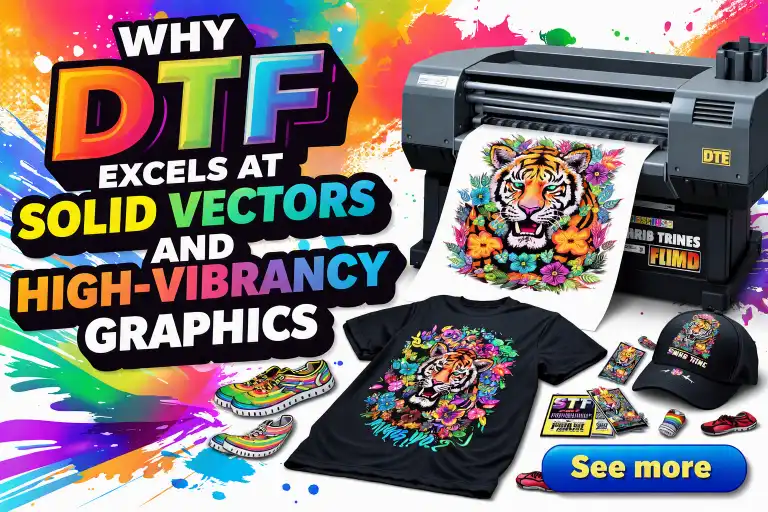
For brands producing custom apparel featuring solid, high-vibrancy vector graphics—such as corporate logos, bold typography, or streetwear designs
DTF is the superior choice. The thick, pigmented ink layers combined with a strong white underbase and adhesive powder produce a saturated look that pops against any color fabric, especially on darker surfaces.
This makes DTF printers highly efficient for teams needing consistent, high-impact results for large-order events or promotional gear.
The Transparency Trap: Challenges with Fades-to-Nothing in DTF
One challenge with DTF is handling designs that fade into transparency.
Because the adhesive powder must grip the ink to facilitate the heat transfer, “fades-to-nothing” designs require careful attention during the digital design phase.
If the gradient dots are too small, the powder may not have enough surface area to bond correctly.
DTG handles these gradients naturally, as it is not dependent on a physical powder to hold the ink to the surface.
Why DTG Remains the King of Breathable Cotton Garments
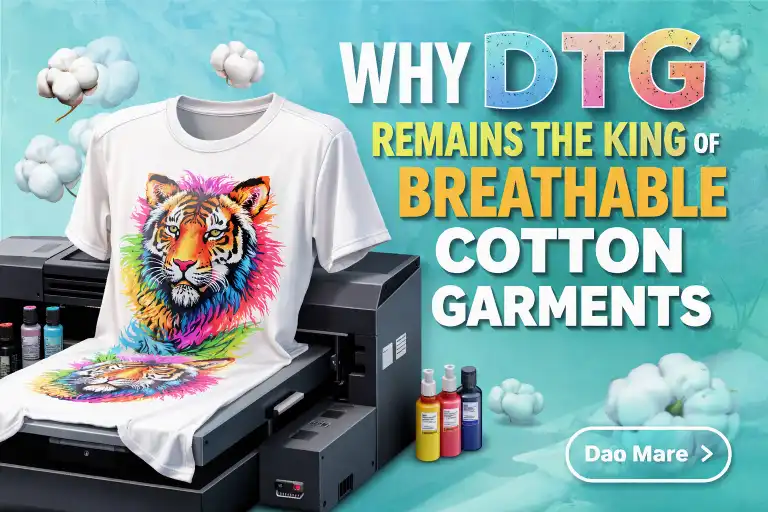
If your primary product is high-quality, 100% cotton apparel such as luxury t-shirts or high-end retail hoodies
DTG remains the undisputed king. The breathability of the garment remains largely unaffected because the ink becomes part of the fiber rather than a separate layer.
For retail brands prioritizing the “soft hand” feel, DTG provides a premium experience that customers can feel, ensuring that the garment stays comfortable even after many wash cycles.
Solving the Synthetic Struggle: Printing on Polyester, Nylon, and Blends
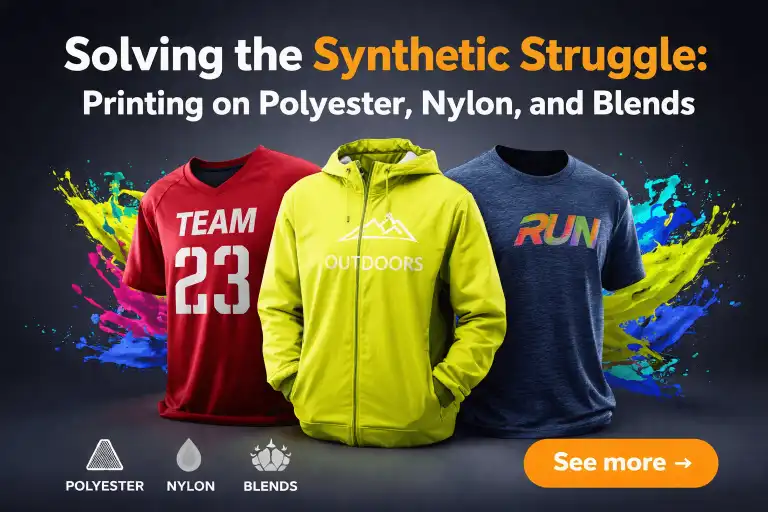
This is where DTF shines. Printing on polyester, nylon, or tri-blends has historically been a headache for screen printing and DTG alike.
DTF bypasses the chemical limitations of these materials by using the heat-activated adhesive as a universal bridge.
Whether you are decorating moisture-wicking athletic gear, nylon jackets, or cotton-poly blends, DTF provides a reliable, consistent bond that will not peel, even on challenging synthetic surfaces.
Heavyweight Challenges: Printing on 480gsm Hoodies vs. 300gsm T-Shirts
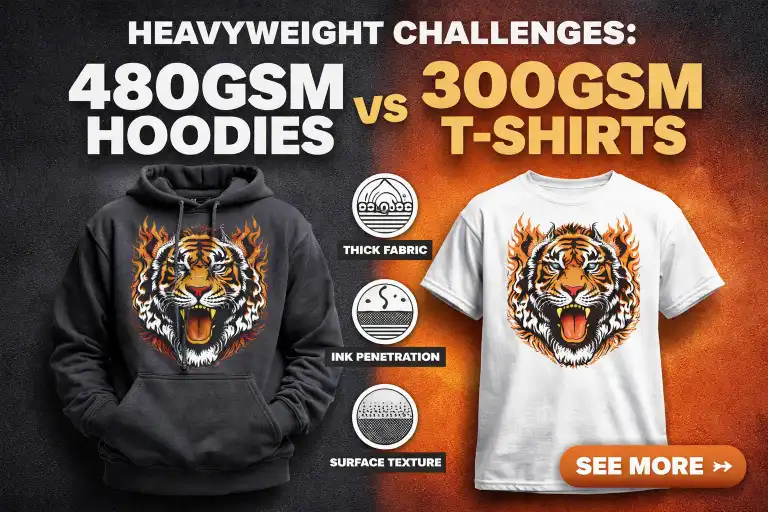
Garment weight impacts print quality. A 480gsm heavyweight hoodie is a different challenge than a 300gsm t-shirt.
DTG printing on heavy fleece requires careful pre-treatment to ensure the ink stays on the surface rather than sinking into the dense nap.
DTF is far more forgiving here; since you are applying a pre-cured transfer, the density of the hoodie does not affect the print quality or color saturation, making it perfect for custom streetwear projects involving heavier textiles.
Specialized Surfaces: From Sportswear to Outerwear and Bags
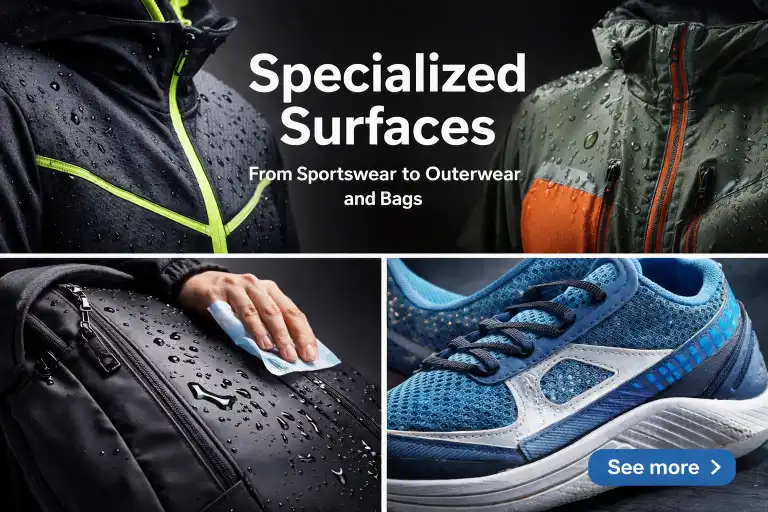
DTF allows you to expand your product catalog beyond standard garments.
Because you can apply the transfer to almost any surface that can withstand a heat press, you can easily decorate bags, hats, umbrellas, and heavy canvas jackets.
This operational versatility allows for a “one-printer” solution for a diverse range of custom merchandise, significantly increasing the utility of your production floor.
The Soft Hand Feel: Why DTG Wins for Boutique and Retail Brands

For the fashion-conscious consumer, the “hand feel” of the print is a critical metric of quality.
DTG is the benchmark for softness. Because the ink is effectively dyed into the fabric, there is virtually no tactile difference between the printed area and the surrounding garment.
This makes it ideal for boutique brands that want to offer a premium, non-intrusive finish that reflects the quality of their apparel business.
Addressing the “Plastic” Texture: The Reality of High-Density DTF
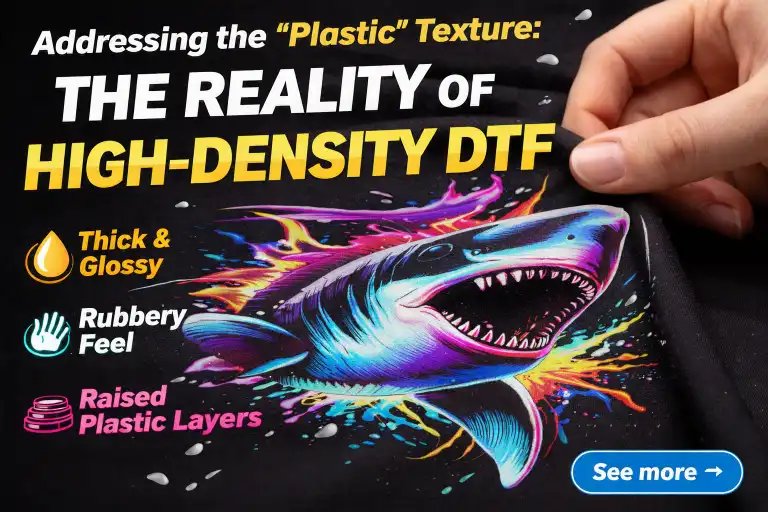
Critics often point to the “plastic” or “rubberized” feel of DTF.
While early iterations were indeed quite stiff, modern films and refined adhesive powders have drastically reduced this.
Using a lighter coating of adhesive and utilizing the correct heat press temperature and pressure settings can result in a print that is surprisingly soft and flexible.
It may not fully match the “no-feel” of DTG, but it is far more comfortable than older, traditional vinyl heat transfers.
Using DTF “Puff Print” and Specialized Films to Elevate Brand Value
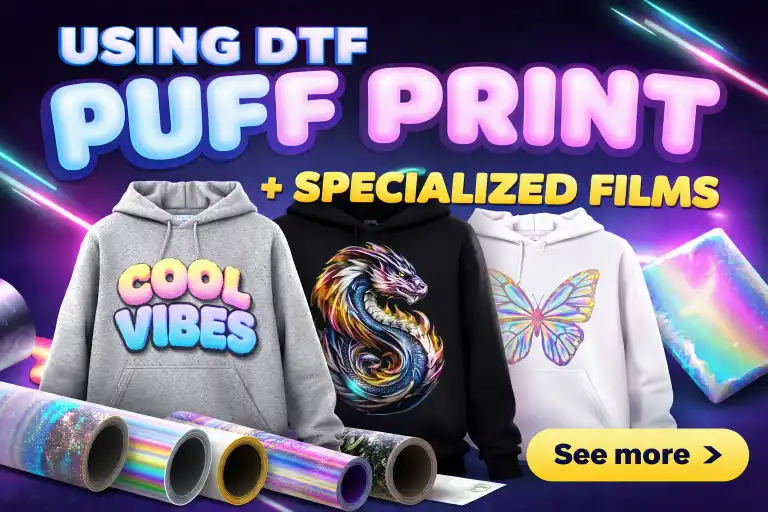
Strategic use of specialized films can turn the texture of DTF into a feature rather than a drawback.
Techniques like puff printing or metallic film overlays allow you to create elevated, high-value finishes that are impossible with standard DTG.
By framing these finishes as a luxury design choice, you can increase your price point and differentiate your brand from competitors in the saturated custom apparel market.
The Pre-treatment Hurdle: The Hidden Time Cost of DTG Printing
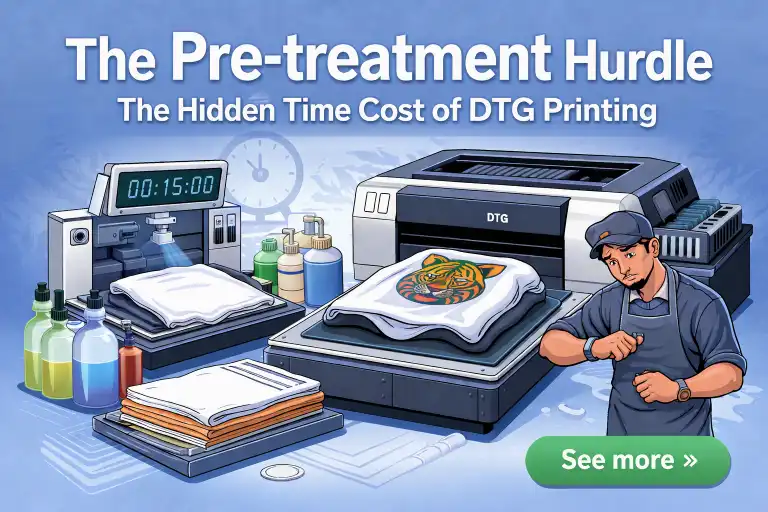
DTG production is notoriously labor-intensive.
The pre-treatment process of spraying the garment, drying it, and ensuring it is perfectly flat can be a massive bottleneck.
If you fail to pre-treat correctly, the print will wash out. This hidden labor cost is often overlooked when calculating the cost estimation and ROI of a DTG printer.
For shops focused on speed, these manual steps can represent a significant limitation on daily production capacity.
The DTF Workflow: Printing, Powdering, and the Curing Oven
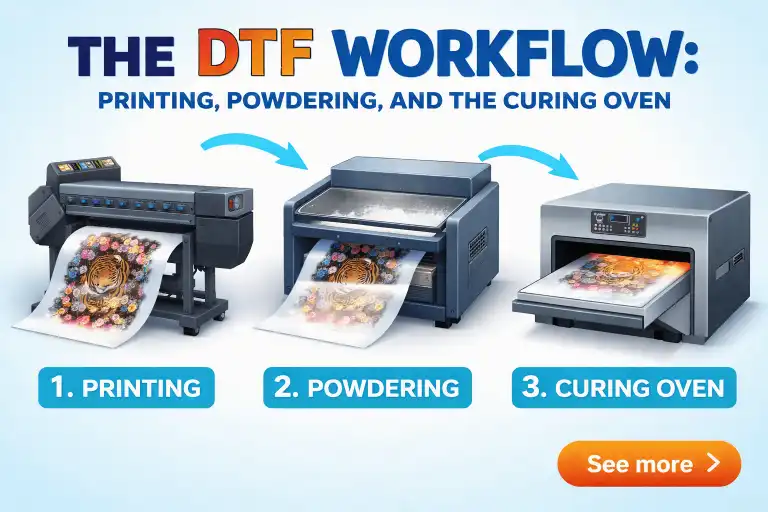
The DTF workflow is different but highly efficient.
You print your design, apply the adhesive powder, and cure it. While this involves more steps, it allows for a “batching” strategy.
You can print and cure a large stack of transfers in the morning and then use a heat press to apply them as orders come in throughout the day.
This separates the “production” of the print from the “fulfillment” of the order, creating a highly scalable model for on-demand production.
Print Management: On-Demand Production vs. Batch Processing
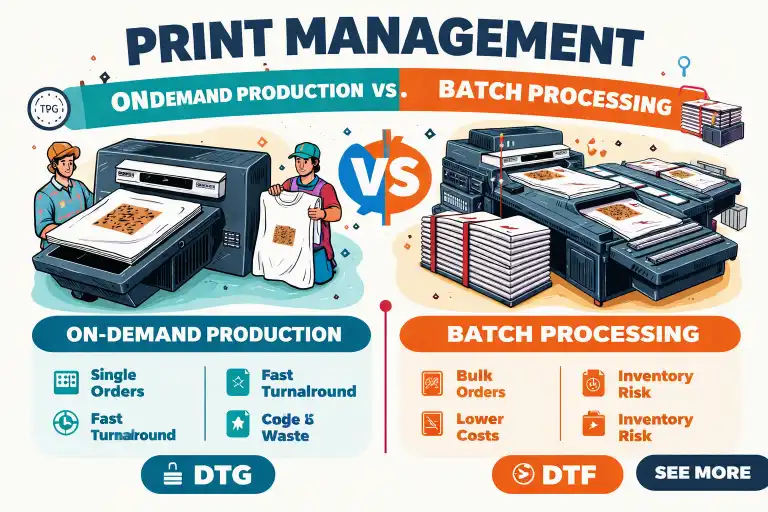
DTG is inherently an on-demand process.
You print once the order is received. DTF allows you to bridge the gap between on-demand and batching.
By keeping a library of popular designs pre-printed on film, you can fulfill orders for a customer in minutes with a simple heat press application.
This significantly increases your daily output capacity compared to the slower, machine-bound cycle of a single DTG printer.
Heat-Pressing Nuances: Temperature, Pressure, and Peel Times
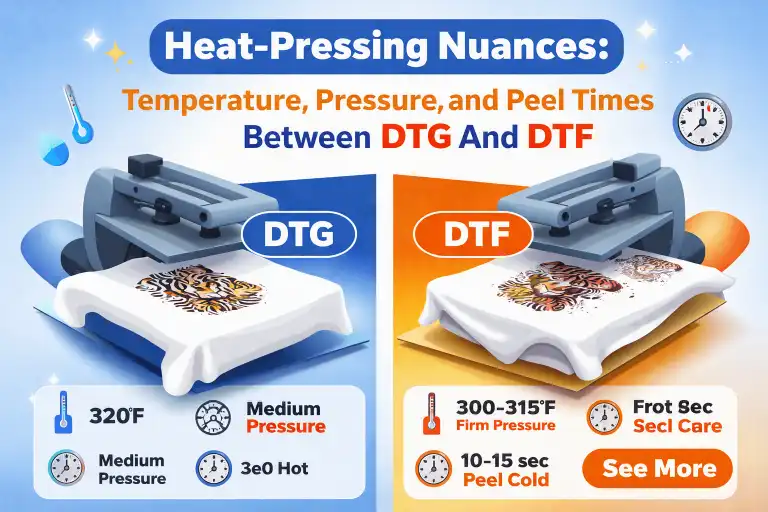
Both methods rely on the heat press, but the parameters differ.
DTG requires a final press to cure the ink into the fabric. DTF requires precise temperature and pressure for the adhesive to bond, and crucially, an understanding of “hot” vs. “cold” peel times for the PET film.
Mastering these nuances through consistent machine maintenance and staff training is what separates a professional, high-output shop from a hobbyist setup.
The Fade Factor: How DTG Ages with the Fabric Fibers
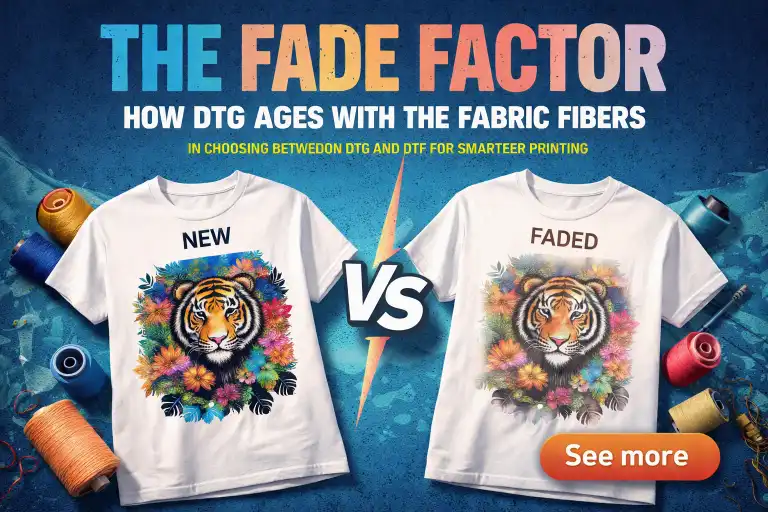
Because DTG ink is infused into the fibers, it ages gracefully.
As the cotton fiber fades through repeated washing, the print fades along with it, maintaining a consistent aesthetic.
While some might consider this a downside, many retail brands actually prefer this “vintage” look, as it avoids the appearance of a cracking, peeling design, which is often a point of concern for customers.
The Crack vs. Peel Reality: Understanding DTF Washability
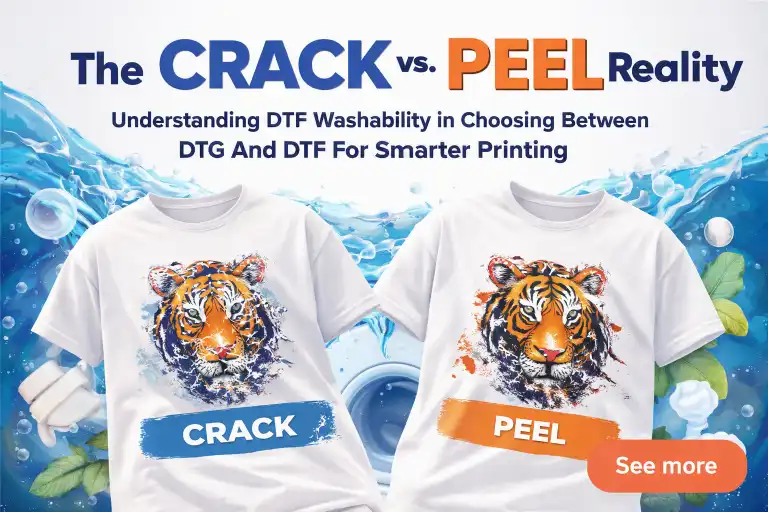
DTF is highly durable, but its failure mode is different.
Because it sits on top of the fabric, a poorly applied transfer will eventually crack or peel if the adhesive bond is weak.
However, if applied correctly with the right temperature and pressure, modern DTF prints are incredibly resilient, often outlasting the garment itself.
The key is in the heat press application—if the bond is solid, the durability is excellent, providing peace of mind for both the decorator and the end customer.
Conclusion
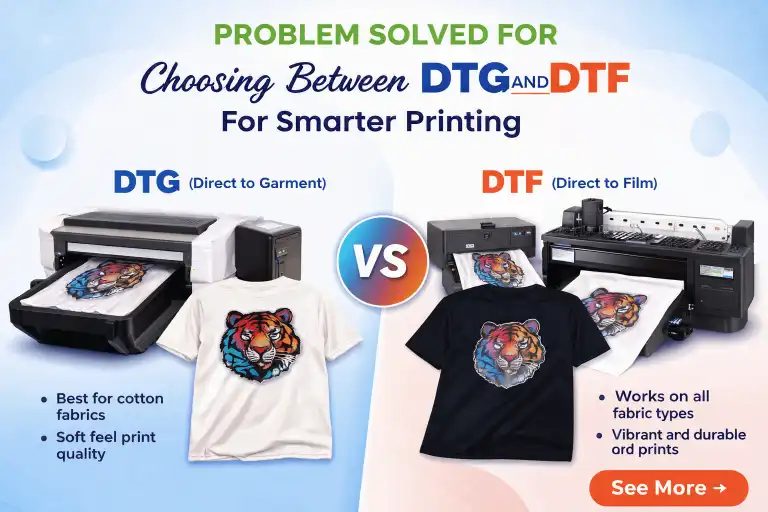
Choosing between DTG and DTF is not a decision about which machine is “better”—it is a decision about which workflow aligns with your business goals.
If your brand lives in the boutique, soft-feel, retail space, the investment in a high-quality DTG printer is justified by the unmatched aesthetic quality.
If your business needs flexibility, large order handling, or printing on many synthetic fabrics, DTF is a necessary and efficient tool.
For many successful shops, the ultimate strategy is a hybrid approach. By maintaining both systems, you ensure that no order regardless of fabric type, volume, or design complexity is ever turned away.
If you understand how the bond works, the hidden workflow costs, and the product’s durability, you can build a stronger, more profitable printing business.
Start by assessing your current order volume and primary fabric types to determine which path provides the most immediate growth for your shop.
